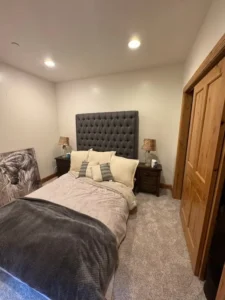

Quick answer: Before finishing a basement in Park City, test for radon (the EPA action level is 4 pCi/L, and Utah DEQ reports about 1 in 3 Utah homes have elevated levels), fix exterior drainage so spring snowmelt moves away from the foundation, repair cracks and confirm the sump or perimeter drain works, and insulate concrete walls with rigid foam rather than fiberglass against bare concrete. Rough in radon mitigation before walls close, even if your first test is low.
Why does basement prep matter more in Park City?
Park City basements face conditions most Wasatch Front basements do not. Snow piles up against foundations for months, then melts all at once in spring. Nights drop below freezing for much of the year at roughly 7,000 feet, so water near the foundation freezes and thaws over and over. Many homes are built into hillsides, which means uphill walls hold back soil and groundwater. And radon, a naturally occurring radioactive gas from uranium in soil and rock, is common across Utah.
Finished walls hide all of these problems. Fixing them before framing costs a fraction of tearing out wet drywall and moldy carpet later.
Is radon a real concern in Park City basements?
Yes. Utah’s Department of Environmental Quality calls radon the second-leading cause of lung cancer and reports that about one in three Utah homes have elevated levels. The EPA and the State of Utah recommend considering mitigation at or above 4 picocuries per liter (pCi/L). Radon levels vary house to house, even on the same street, so the only way to know is to test.
Finishing a basement can change how your family is exposed. Rooms that were storage become bedrooms and theaters where people spend hours. That makes testing before you finish especially important.
How to test
- Short-term test: A 2 to 7 day kit gives a quick read. The Summit County Health Department in Park City offers radon test kits to residents.
- Long-term test: Utah DEQ suggests a long-term test if a short-term result lands between 4 and 6 pCi/L, because levels change with the seasons.
- After the remodel: Test again once the basement is finished and the HVAC is running normally.
Why rough-in mitigation now
A typical active radon system uses a pipe through the slab and a fan that vents above the roof. Running that pipe through an unfinished basement and up a chase is simple. Retrofitting it through finished rooms means opening walls and ceilings. Many owners choose to rough in a passive pipe during the finish so a fan can be added later if a future test comes back high.
How do I keep a Park City basement dry?
Most basement water problems start outside. Walk the house during spring melt or after a heavy rain and look for these issues:
- Grading: Soil should slope away from the foundation. Settled backfill often creates a trough that funnels meltwater toward the wall.
- Gutters and downspouts: Downspouts should discharge well away from the foundation. In snow country, ice dams and roof avalanches often damage gutters, so check them every spring.
- Snow storage: Avoid piling plowed or shoveled snow against the foundation or over window wells.
- Window wells: Wells need a gravel base and a working drain, ideally covered. See our guide to egress windows and wells in Park City.
- Foundation cracks: Hairline shrinkage cracks are common. Cracks that leak, widen or show displacement need repair or an engineer’s review before finishing.
- Sump and perimeter drain: If the home has a sump, confirm the pump runs, discharges away from the house and has a reliable backup.
What insulation works best for a basement at 7,000 feet?
Cold, damp concrete and fiberglass batts are a bad combination. Warm, moist indoor air reaches the cold concrete behind the batts, condenses and feeds mold. For Park City’s cold climate, a safer approach is:
- Rigid foam against the concrete. Foam board or closed-cell spray foam on the wall keeps the concrete-facing surface warmer and limits condensation.
- Framing inside the foam. A stud wall built inside the foam holds wiring and drywall, and can include additional insulation.
- Thermal break at the floor. A subfloor system or insulated underlayment makes a big comfort difference on a cold slab, especially in a ski room or bunk room.
- Rim joist sealing. The band joist at the top of the foundation is often the leakiest spot in the house. Insulate and air-seal it.
Your plan reviewer will confirm insulation requirements for your climate zone during permitting. Learn which office reviews your plans in our Park City basement permit guide.
Are there Park City soil issues to know about?
Yes, in some neighborhoods. Parts of Park City sit on soils affected by historic mining and mill tailings, which can contain elevated arsenic and lead. The city’s Soil Cover Ordinance sets topsoil and landscaping rules inside a defined boundary. If your prep work involves regrading or digging new window wells, confirm whether your property falls inside that boundary first.
The 10-step Park City basement prep checklist
- Run a radon test, and a long-term test if results are borderline.
- Walk the exterior during snowmelt or heavy rain.
- Regrade soil so it slopes away from the house.
- Repair gutters and extend downspouts.
- Clean, drain and cover existing window wells.
- Seal or repair foundation cracks; get an engineer’s review for structural cracks.
- Confirm the sump pump and perimeter drain work.
- Check the soil ordinance boundary before any excavation.
- Plan rigid foam insulation, rim joist sealing and a warm floor.
- Rough in a radon mitigation pipe before walls close.
Frequently asked questions
Should I test for radon before or after finishing my basement?
Both. Test before you design so mitigation can be planned, then test again after the work is complete and the home is operating normally.
Where can I get a radon test kit in Summit County?
The Summit County Health Department offers radon test kits, and Utah’s state radon program lists other sources. Hardware stores and certified radon professionals are additional options.
Can a dehumidifier replace drainage fixes?
No. A dehumidifier helps manage indoor humidity, but it will not stop liquid water entering through the foundation. Fix grading, gutters and drainage first.
Is it safe to install carpet in a Park City basement?
It can be, once moisture is controlled and the floor has a thermal break. For ski rooms and areas near the garage entry, tile or luxury vinyl plank handles wet boots better.
When is the best time to do basement prep work in Park City?
Late spring through early fall is best for exterior grading, excavation and well work. Interior finishing can continue through winter once the outside work is done.
Build on a dry, healthy foundation
DreamBuilt Renovations checks drainage, radon and insulation before every basement finishing project in Park City and across Summit County, including Kamas and the Snyderville Basin. Planning a bathroom downstairs? See our basement bathrooms page, or review what a Park City basement finish costs. When you are ready, schedule a consultation.